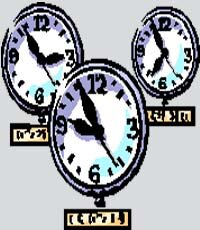
When you are learning a new language, vocabulary is definitely one of the first things that you must learn. While you are learning new words, you are improving your skills. Telling time in Portuguese is just a matter of knowing some important phrases and a few formulas and rules, in few words, it is not difficult to learn the vocabulary of time in Portuguese.
This is a specialized designed section where you will learn some of the most common and useful phrases to ask the time in Portuguese. So, if you are looking for the best place to learn about Portuguese Time, this is the right place,
Portuguese Vocabulary for Knowing the Time
Asking the time
Here are some expressions you can use when you want to know the time. Each of them have the same meaning (What time is it?):
Que hora é ele?
Por favor, que horas são?
Que horas são?
Telling Time in Portuguese
In Portuguese, to tell someone what the time is, is very similar to English.
You first say the hour number, then the word “e” and finally the minute number. São dez e vinte. - It's ten twenty.
For “sharp hour”, you say: São sete horas / São sete horas em ponto. - It’s seven o’clock / it’s 7:00 am sharp
For “half an hour”, you can use the expression “e meia” in the place of "and a half": São cinco e meia (It’s five thirty)
To answer the minutes after the first 30 minutes, it is more frequent to say the residual time to the next hour, using the structure: São + remaining time in minutes + para as + next hour. São cinco para as cinco - It's five to five.
For midnight and midday in Portuguese: É meia-noite - It's midnight É meio-dia - It's noon
In Portuguese, when referring to “am” or “pm”, use the expressions “da manhã”, “da tarde” or “da noite”. Those expressions are used with specific time. A reunião começa às 6:00 da tarde. - The meeting starts at 6:00 pm
When you want to express that an event occurs at a precise time use the preposition “às” (at). A cerimônia começa às 9:00 - The ceremony starts at nine o’clock.
For express the time that an event begins and ends uses the structure: from (hour) to (hour) = das (horas) às (horas) or the structure das (horas) até as (horas).
A cerimônia será das 9:00 até às 10:00.
The ceremony will be from nine to ten.
A cerimônia será das 9:00 até as 11:00.
The ceremony will be from nine till eleven.

 Portuguese Language
 Portuguese Pronunciation
 Portuguese Grammar
 Portuguese Vocabulary
 Portuguese Language Tools
 Learning Portuguese
 Portuguese Culture